Archive for the ‘The Whats and Hows’ Category

Ghee (Clarified Butter)

Monday, August 25th, 2008

Ghee is Clarfied butter.

It is used extensively in India in a lots of recipes including desserts. It is made by boiling unsalted butter, till all the moisture is gone and it turns a light golden yellow.

This form of butter has a lot of benefits over traditional butter. It has high smoking point, so it does not burn while cooking. Also while clarifying the butter the solid milk protiens are removed. As a result it becomes lactose free - a more tolerable product for lactose intolerant people.

Ingredients:

  1. 4 sticks of unsalted Butter
  2. 1 very large deep heavy bottomed pot


Preparation:

Heat the unsalted butter in low flame. It will slowly melt and start bubbling and boiling. If you are making this is a deep pot you will not need to worry about spilling over.

 
Do not stir. This might take upto an hour. Gradually you will see the foam forming on the top, the solids depositing at the bottom of the pan and the butter getting transparent.

Be careful not to burn the solids at the bottom of the pot. They should remain at a dark yellow color with tinges of brown in them.

The foam at the top will slowly clear up and get deposited at the bottom.

You will know if its done once the liquid is transparent light golden color. The deposit should be dark yellow. Do not stir.  Strain the clarified butter, and discard the brownish deposit.


Note: Ghee at room temperature looks semi-solid. Ghee does not need to be refrigerated. Always use a clean utensil to scoop out ghee for use.

Share/Save/Bookmark

Garam Masala

Monday, August 25th, 2008

Garam means Hot, and Masala means Spice.

Garam Masala(Whole Spices)

Garam Masala(Whole Spices)


Garam Masala is referred to a combination of different spices. They may be used whole or ground into to a powder. If its used whole they are usually added in the beginning of the recipe, and if used in the powder form, its sprinkled on the dish after its done cooking.

The hot in garam masala is not the same kind of hot as in hot green peppers. It actually are the spices which raises the body temperature. Therefore garam masala is used in very little quantity. I usually use about only 1/3 teaspoon of garam masala in a recipe for a serving of 4-5.

The following is the recipe for Punjabi Garam Masala. The spices may or may not be roasted prior to grinding. For this particular recipe, I do not roast the spices.

Ingredients:
2 tablespoons whole Coriander seeds
1 tablespoon Cumin
2 tablespoons small green cardamom
2 tablesoons cloves
2 tablespoons peppercorns
4 sticks of cinnamon, approx. 2″ each
3 Bay Leaves
3 Red Dried Peppers
1/2 teaspoon of nutmeg

Preparation:
Grind all ingredients dry in a spice or coffee grinder.

May be stored in air tight containers for many months.

Share/Save/Bookmark

What is Tarka?

Monday, August 25th, 2008

Tarka is technique where spices are added to very hot oil. When the spice seeds are added to the hot oil, they pop and sizzle bringing out the intense flavor and aroma.

Tarka might be done in different ways:

Its either done at the beginning of a recipe, and then the other ingredients are added to it. So its cooked in the seasoning and flavored oil.

It is also may be done after the dish is cooked. The spices are added to the hot oil, and when the Tarka is done, the oil along with the spices are poured over the dish, stirred and covered to retain and intensify the flavor.

Sometimes it may be done both at the beginning and the end.

Other names of Tarka: “Chhownk” & “Baghaar

Share/Save/Bookmark

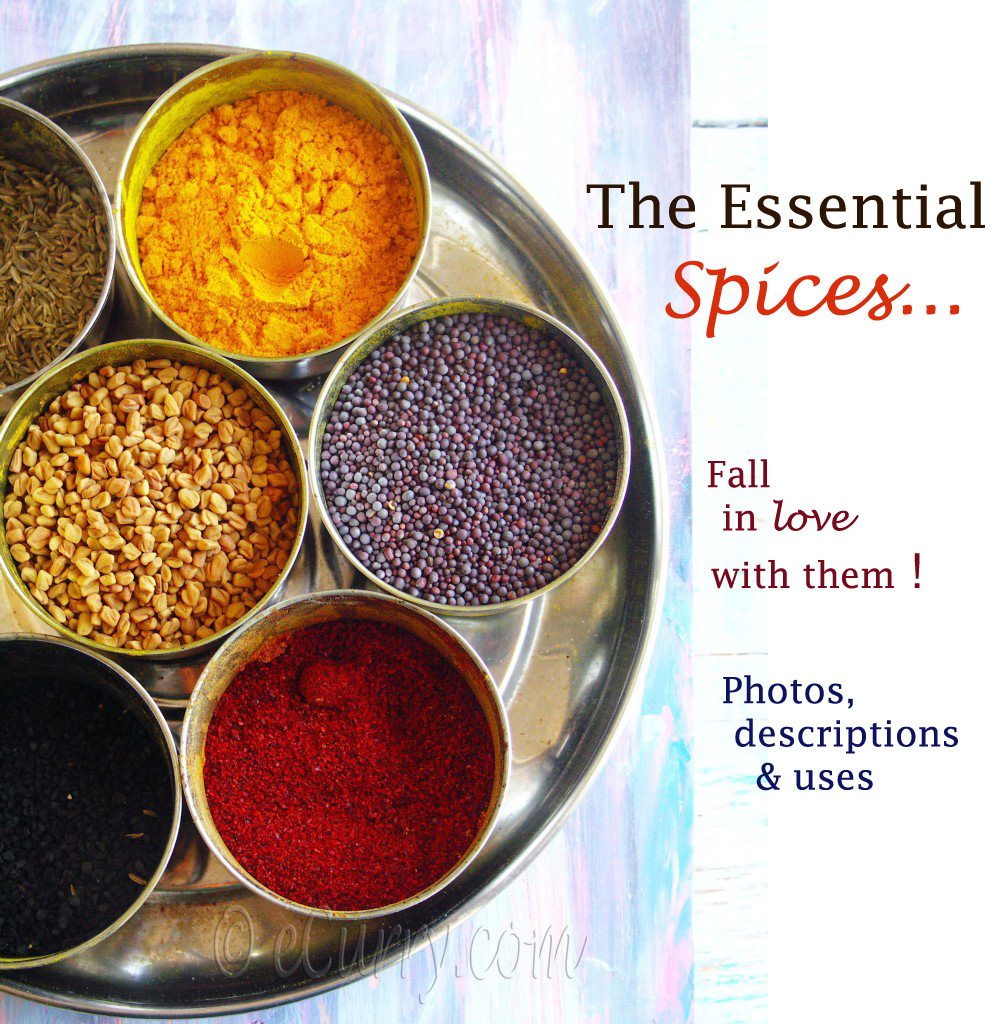
The Most Commonly Used Indian Spices

Sunday, August 24th, 2008
Asafoetida

Asafoetida

Asafoetida (Hing): This is sap from stem and root of a plant, dried into a hard resin. It has a very very strong aroma.
I personally use it in preparation of Lentils and Dry Fries.


Bay Leaves

Bay Leaves

Bay Leaves (Tej Patta): Dried bay leaves. They are browned in oil first increase the aroma.


Carom Seeds

Carom Seeds

Carom Seeds (Ajwain): These are pungent ( like Thyme), but looks like celery seeds. Very strong flavored. It also has good digestive properties.
I mostly use it when I make Parathas.


Cinnamon

Cinnamon

Cinnamon (Darchini) This is actually dried bark of a tree. It’s an ingredient of Garam Masala.


Clove

Clove

Cloves (Laung): Cloves are dried up flower buds. Used as a part of Garam Masala in the ground form, or in the stick form in meats and vegetables.


Coriander Seeds

Coriander Seeds

Coriander Seeds (Dhania): These seeds are actually dry seeds of the regularly used fresh cilantro. These seeds are usually used in the ground form to be a part of various spice mixes, like Garam Masala, Sambar Powder. 


Cumin Seeds

Cumin Seeds

Cumin Seeds (Jeera): Very commonly used and in various dishes. Its used both whole and dry roasted and ground.


Fenugreek seeds

Fenugreek seeds

Fenugreek Seeds (Methi) : Angular buff colored seeds having a slightly bitter taste. One of the mixtures of Panch Foron. The unripe, raw seeds are cooked as side dishes in certain parts of India and they are not bitter!!
I use these seeds quite frequently, especially in the Makhani masala.


Fennel Seeds

Fennel Seeds

Fennel Seeds (Saunf or Mouri): These look like Cumin Seeds, but when looked closely they are actually greener and wider. Fennel is another ingredient of the Panch Foron.These are also dry roasted and used with tiny sugar candies to make mouth freshnersafter meals. Fennel is known for its digestive qualities.


Green Cardamom

Green Cardamom

Green Cardamon (Choti Elaichi) : These pods holds tiny little balck seeds inside. The seeds are taken out and used whole in cooking or in the from of powder. Its used in a LOT of Indian cooking whether it be vegetables, meat, rice or even desserts. Cardamom is also an important part of Garam Masala.


Cardamon Black(Badi Elaichi) : These are bigger than the small green cardamoms and black in color. Has a much stronger aroma.


Mustard Seeds

Mustard Seeds

Mustard Seeds (Sarso or Rai): These are usually added to hot oil to season vegetables, lentils, rice and pickles. Mustard is also ground and used in cooking fish and vegetables in the Eastern part of India.


Nigella/Kalonji

Nigella/Kalonji

Nigella (Kalonji/Kalo Jeera) : These are tiny black seeds mostly forming a part of the Panch Foron. They are also used in breads (tandoori rotis), parathas, and to season some vegetables. In the Eastern India this is extensively used to season fish.These are tiny black seeds mostly forming a part of the Panch Foron. They are also used in breads (tandoori rotis), parathas, and to season some vegetables. In the Eastern India this is extensively used to season fish.


Nutmeg

Nutmeg

Nutmeg (Jaiphal): These are seeds of a fruit. The part that is actually used is the inner part of this seed. Its used in ground form, mostly in biriyanis. Unlike in western countries, its almost never used in desserts in Indian cooking.


Panch Foron

Panch Foron

Panch Foron: This is a five mix spice. “Panch” means “five”. The following are used in equal amounts:
Cumin Seeds
Mustard Seeds
Nigella Seeds
Fenugreek Seeds
Fennel Seeds
This is extensively used in East Indian cooking.


Red Chilli Powder

Red Chilli Powder

Red Chilli Powder: This is ground up red chili powder.


Red Dry Chilli

Red Dry Chilli

Red Dry Chilli: This is the hot peppers dried up, esp. the cayenne pepper type. They have different flavor then the green hot peppers are are usually sizzled in oil and cooked up with the vegetables or meat.


Saffron

Saffron

Saffron (Kesar): This is probably the most expensive spice. Looks like tiny orange threads, these are actually the stigmas of a flower called crocus.
Adds beautiful flavor and color to rice dishes, gravies and desserts.


Turmeric

Turmeric

Turmeric: Turmeric is actually a ginger like rhizome in the raw state. The inside is orangish yelllow in color. The rhizome is dried and ground for the purpose of cooking. It gives the food a yellowish color. Turmeric is also known for its antiseptic qualities. Raw turmeric is often times ground into a paste and used to improve skin and complexion.


Share/Save/Bookmark

Roasted Cumin Powder

Monday, August 18th, 2008

Ingredients:

2 Tablespoons Cumin Seeds


Preparation:

In a pan add the cumin seeds and roast at medium heat till they are dark brown and fragrant. Remove from heat and let it cool.

Grind into fine powder.


This can be stored in the airtight containers for a couple of months.


[I grind it in the dry coffee grinder. It can also be done with a rolling pin on cutting board]

Share/Save/Bookmark